 Technologies
New Digitalization Trends in FinTech
The innovations reshaping fintech.

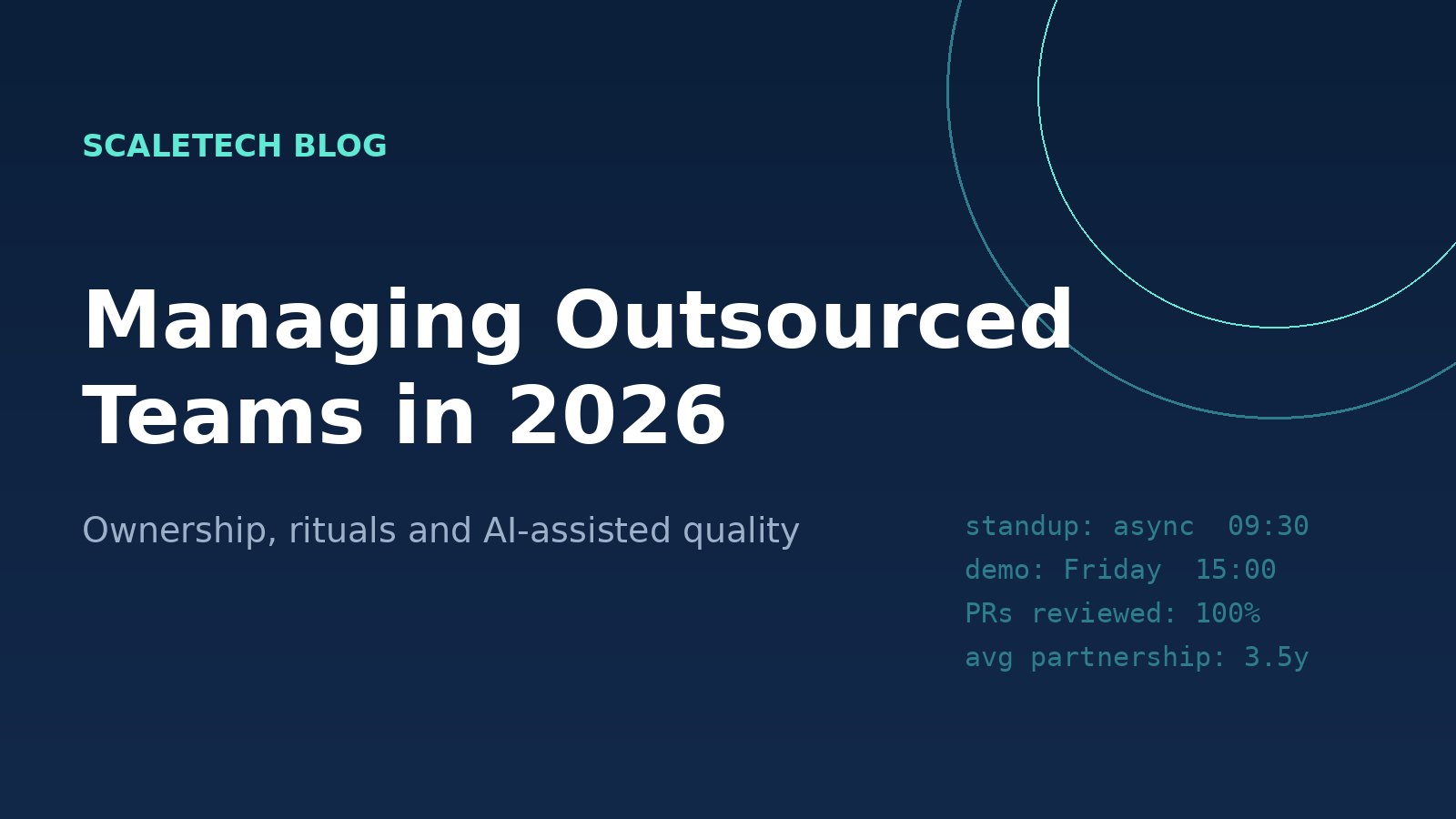
Outsourced teams fail on ownership, not skill. In 2026 the playbook is: one accountable product owner on your side, the vendor's engineers inside your daily rituals and tools (not behind a PM wall), weekly demos of working software, and AI-assisted code review making quality visible to non-engineers. Measure outcomes shipped, not hours logged.
We have sat on both sides of this table — as the outsourced team for clients in 12+ countries, with partnerships averaging 3.5 years. The teams that succeed with us and the ones that struggle do predictably different things. This is the 2026 version of that playbook.
Two shifts. First, AI-assisted development compressed delivery cycles: a vendor team's output doubled, which means a slow feedback loop on your side is now the bottleneck, not their velocity. Second, remote-first collaboration matured — nobody debates tools anymore, so the differentiators moved up the stack: decision speed, context sharing and ownership clarity.
The single biggest predictor of success we see: whether external engineers sit inside your Slack, your standups and your repo — or behind a vendor PM who translates. Translation layers add days of latency and strip context. Give the team direct access to the people who know why a feature exists. Keep one escalation point on each side for commercial topics; everything technical flows straight between engineers.
You need exactly one empowered product owner who answers questions within hours, ruthlessly prioritises, and accepts or rejects work weekly. What you should not micromanage is implementation: a senior outsourced team chooses its own patterns and tools within your architecture guardrails. If you find yourself reviewing variable names, you hired the wrong partner — or you are the bottleneck.
In 2026 you can verify quality without reading code: ask for CI that blocks on tests, a weekly demo of working software on a staging URL, and AI-assisted review reports (we run them on every PR) summarising risk in plain language. Insist on observability from day one — if the team cannot show you a dashboard of errors and latency, they are flying blind and so are you.
Time-and-materials with a rolling 30-day exit beats fixed-price for anything longer than a prototype — fixed price buys you scope fights, not safety. Pay for a dedicated team, not pooled hours: continuity is where outsourcing compounds, and our longest client relationships are the ones where the same engineers stayed for years. Add full IP transfer and a staging-access clause on day one, not at divorce.
Monday: priorities confirmed in writing. Daily: async standup where blockers get names attached. Friday: demo of working software, not slide decks. Monthly: retro including your side's performance — slow answers and shifting priorities are management failures, not vendor ones. Teams that keep this rhythm ship; teams that skip demos drift. It really is that boring, and that reliable.
TechnologiesThe innovations reshaping fintech.
 Technologies
Picking a framework for fast apps.
 Mobile
Why Flutter is a popular choice.