 Technologies
New Digitalization Trends in FinTech
The innovations reshaping fintech.

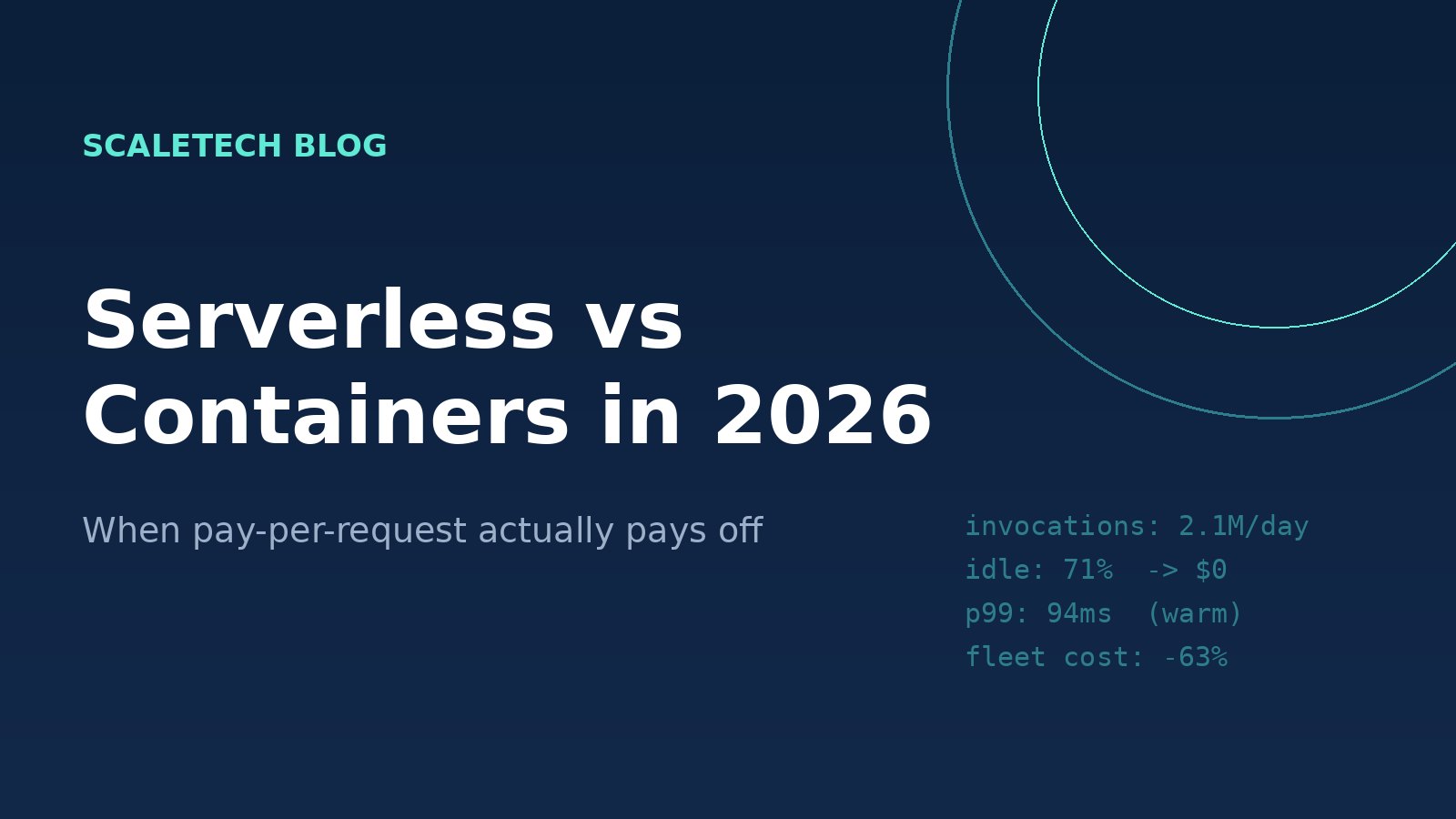
In 2026, serverless wins for spiky or unpredictable workloads, event processing and APIs with idle periods — you pay per request and scale to zero. Containers win for steady traffic, long-running jobs and latency-critical paths. Most production systems we run use containers as the backbone with serverless at the edges.
We operate backends for fintech and mobility products where the infrastructure bill and the 3am pager both land on real people. The serverless question stopped being religious around 2024 — now it is pure economics. Here is how we decide in 2026.
Cold starts mostly stopped mattering: provisioned concurrency, SnapStart and edge runtimes cut typical cold paths under 100ms. Pricing transparency improved, and so did the tooling for local development. At the same time, container platforms got boring in the best way — a small Kubernetes or ECS/Fargate setup is now a solved, well-documented problem. The result: fewer wrong-by-default choices, more cost-driven ones.
Three patterns keep proving themselves in our client work. Spiky traffic: a ticketing system that sells out in minutes, then sleeps — paying for peak capacity 24/7 is burning money. Event pipelines: webhooks, file processing, notifications — glue code that runs seconds at a time. Early-stage products: when you do not yet know your traffic shape, scale-to-zero means your mistakes are cheap. A public-transport client of ours processes fare events serverlessly for a fraction of what a always-on fleet would cost.
Steady, predictable load flips the math — at constant utilisation, reserved containers cost several times less than the same compute bought per-request. Long-running work (reports, ML inference, websockets), strict p99 latency targets, and anything needing fine-grained runtime control also belong in containers. And regulated fintech workloads often land here for a duller reason: auditors understand a container with a pinned image better than a function that changed runtime last night.
Nearly every system we run in 2026 is a hybrid: a containerised core API (predictable, observable, cheap at steady load) with serverless functions for queues, webhooks, scheduled jobs and burst endpoints. The anti-pattern to avoid is the accidental distributed monolith — fifty functions calling each other synchronously. If functions form a call chain, they wanted to be a service.
Plot a week of traffic. If utilisation is under ~20% or spikes are over 5x baseline, serverless the spiky parts. Price both options with your real numbers — the napkin math takes an hour and regularly saves thousands per month. Then choose per workload, not per company: the question is never "are we a serverless shop", it is "does this workload idle".
TechnologiesThe innovations reshaping fintech.
 Technologies
Picking a framework for fast apps.
 Mobile
Why Flutter is a popular choice.